An AI pilot finishes without a route into production
The demonstration works, but the process owner, data access or acceptance criteria remain unresolved.

We help business and technology leaders test where AI can improve a defined workflow, then build the controls and operating model needed to use it.


The demonstration works, but the process owner, data access or acceptance criteria remain unresolved.
Manual analysis, document handling or transaction work consumes the capacity needed.
Projects compete for funding without a shared architecture or economic baseline.
The team needs a defined approach to access, source grounding and human review before proceeding.
Four steps take the work from framing the question to executing the agreed changes, with service-specific activities and a decision gate at the end of each step. We agree the scope, evidence requirements and owners for each phase before work starts.
Duration: 1–2 weeks
Observe the work with users; measure volume, effort, quality and cost and identify data restrictions.
Process owner approves the workflow baseline; data access and confidentiality requirements are agreed.
Duration: 8–12 weeks
Prioritise a bounded use case, define a test set and compare build, buy and process-only options.
Partner signs off evidence versus assumptions; business and technology owners approve the pilot scope and acceptance thresholds.
Duration: 4–6 weeks
Test quality, failure modes, time saved and user adoption against the starting workflow.
Production requires documented acceptance of quality, controls, operating ownership and unit economics—not a successful demo alone.
Duration: 6–18 months
Deploy accepted solutions in waves, embed them in daily workflows and build the monitoring, support and capabilities needed to sustain adoption.
Each production release requires business and technology acceptance; owners confirm quality, confidentiality controls and realised value before handover.
Our proprietary AI harness manages agreed confidentiality requirements and supports source-grounded analysis. Senior consultants validate findings and distinguish evidence from assumptions.
Step 1: Frame
Agreed workflow scope, business owner and success measures, with data access, confidentiality and human-review requirements. Define how effort, quality, cost and value will be measured.
Step 2: Diagnose
A workflow baseline and ranked build, buy and process-only options. Quantify potential value against implementation, integration, compute and support costs; distinguish capacity released from cashable savings.
Step 3: Validate
A working pilot, source-grounded test results and control checks against agreed thresholds. Validate quality, adoption, unit economics and payback, with explicit evidence for the release decision.
Step 4: Execute
An owned rollout plan, monitoring rules and support model. Track realised adoption, quality, cost per transaction and net economic benefit after ongoing technology costs, with assumptions reconciled to actual results.
Each phase leaves a working asset with an owner, source references and an update process. Economic estimates distinguish potential value from approved commitments and realised results.
Illustrative example
Inspect test-level results, source-grounding evidence and confidentiality controls, with explicit thresholds for a production release.
Sample data, not a client deliverable. The format is tailored to the engagement.
View full-size example ↗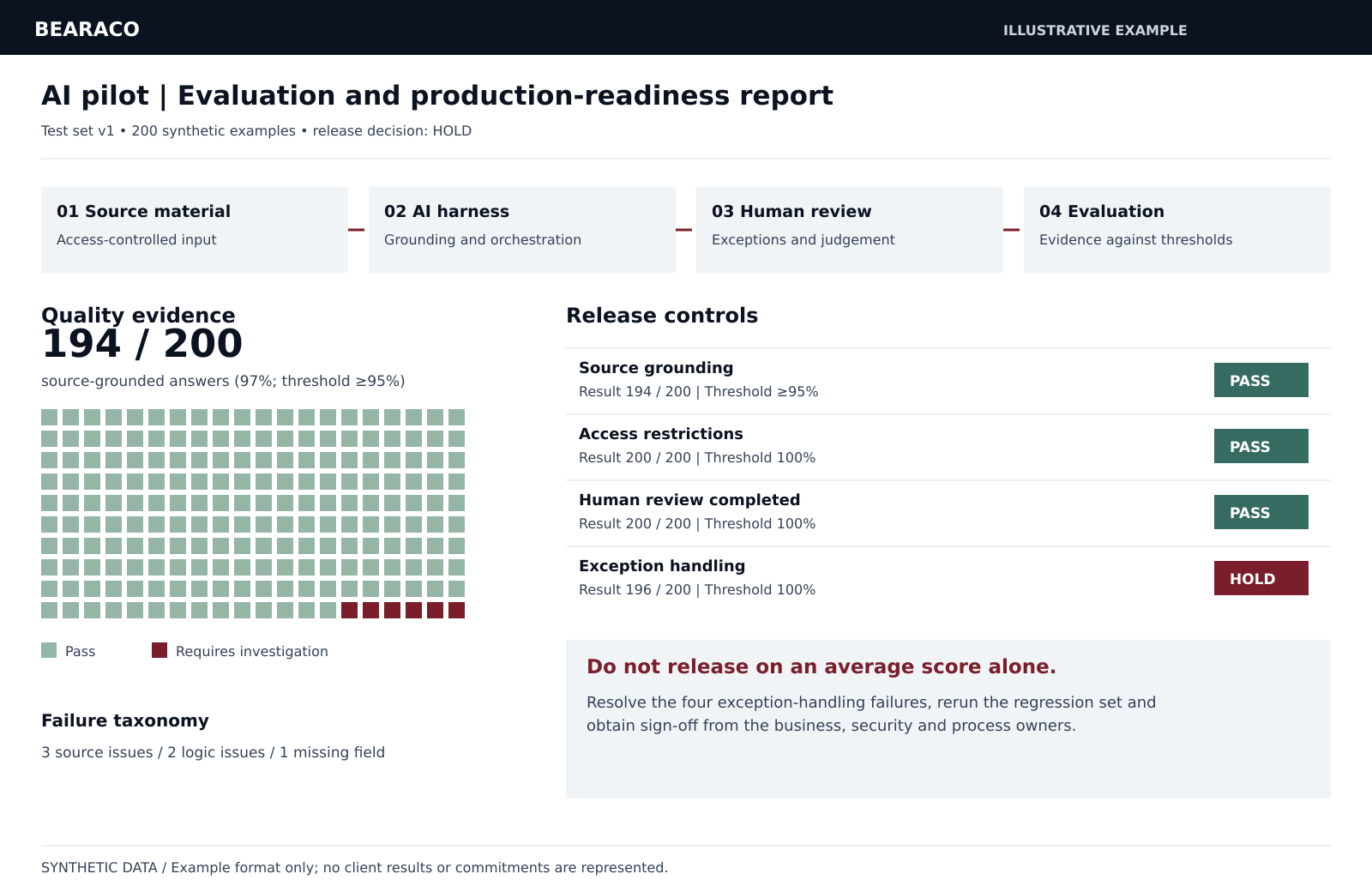
You get direct access to partner judgement, a team working inside your business and a shared focus on economic impact. We work through the difficult questions with you and stay close as decisions become action.
Selected anonymised engagements. Many span several services; each case shows the relevant areas of work alongside its outcome.

Consumer & Retail · Technology & AI · Operating Model · Cost Out
European aftermarket group

Transportation & Logistics · Technology & AI · Strategic Decisions
Passenger rail operator

Financial Services · Cost Out · Technology & AI
European insurance and banking group
Figures are approximate. EUR conversions are documented in the full cases. These engagements illustrate experience, not forecasts for a new assignment.
If an existing tool already meets the need and the workflow has a clear owner, test that option internally before commissioning a bespoke AI build.