A divestment leaves the old support structure behind
Group and business-unit responsibilities still serve a business that no longer exists.

We help CEOs, COOs and functional leaders redesign responsibilities, capabilities and interfaces when the organisation no longer fits the business.


Group and business-unit responsibilities still serve a business that no longer exists.
Integration has not resolved ownership, service levels or overlapping capabilities.
Approvals still cross the same interfaces and escalation remains routine.
Work must move between sites, shared services or suppliers without losing critical capability.
Four steps take the work from framing the question to executing the agreed changes, with service-specific activities and a decision gate at the end of each step. We agree the scope, evidence requirements and owners for each phase before work starts.
Duration: 1–2 weeks
Map roles, decisions, activities, service levels and interfaces alongside the people and cost baseline.
HR and finance reconcile roles and costs to their source systems; disputed ownership is recorded.
Duration: 8–12 weeks
Compare central, local, shared and external delivery models against service and capability needs.
Sponsor selects a model only after decision rights, service impacts and transition risks are reviewed.
Duration: 4–6 weeks
Translate the design into role mapping, interfaces, service agreements and implementation waves.
Line owners accept the transition plan; people, service and regulatory dependencies have named owners before launch.
Duration: 6–18 months
Implement the new roles, interfaces and service model in waves, working alongside line leaders to build capability and maintain service continuity.
Each wave requires readiness sign-off; line owners accept service performance, decision rights and the handover.
Step 1: Frame
Agreed organisational scope, design principles, service requirements and decision owners. Set the measures for cost, capacity, accountability and service continuity before evaluating structures.
Step 2: Diagnose
A reconciled map of roles, activities, decisions and costs, with central, local and shared-service options. Quantify recurring cost implications, capacity changes and transition costs alongside service risks.
Step 3: Validate
Validated decision rights, role maps and service agreements, with implementation waves and readiness gates. Confirm net recurring savings, one-off costs and payback with finance and line owners.
Step 4: Execute
An owned migration plan, readiness checks and service-performance dashboard. Track actual cost, capacity and service levels against the baseline, distinguishing released capacity from realised savings.
Each phase leaves a working asset with an owner, source references and an update process. Economic estimates distinguish potential value from approved commitments and realised results.
Illustrative example
Map responsibilities across the group, business units and shared services, with an accountable owner for each key decision.
Sample data, not a client deliverable. The format is tailored to the engagement.
View full-size example ↗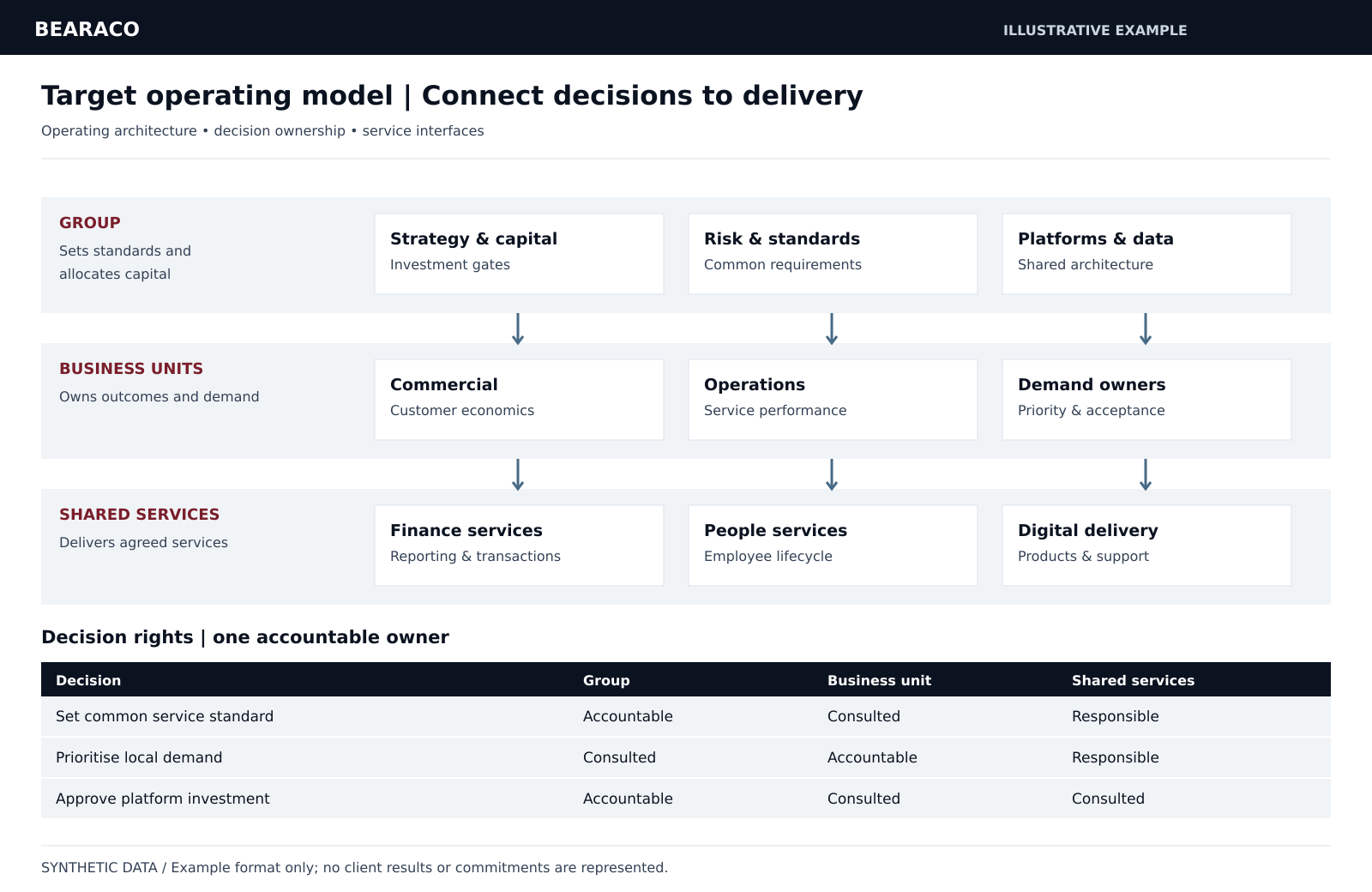
You get direct access to partner judgement, a team working inside your business and a shared focus on economic impact. We work through the difficult questions with you and stay close as decisions become action.
Selected anonymised engagements. Many span several services; each case shows the relevant areas of work alongside its outcome.

Construction & Real Estate · Operating Model · Cost Out
European construction group

Telecom & Technology · Operating Model · Cost Out
Telecom operator

Consumer & Retail · Technology & AI · Operating Model · Cost Out
European aftermarket group
Figures are approximate. EUR conversions are documented in the full cases. These engagements illustrate experience, not forecasts for a new assignment.
If the issue is a single unclear interface and the accountable leaders can agree ownership directly, resolve it locally rather than launching an organisation-wide redesign.