A savings programme is announced without a tracking baseline
The target is public, but finance and the line cannot agree how delivery will be measured.

We help CFOs and operating leaders turn cost targets into owned initiatives and traceable financial realisation.


The target is public, but finance and the line cannot agree how delivery will be measured.
Programme reporting counts actions or run-rate estimates while the cost base stays unchanged.
Functions challenge the definitions before they will accept a target.
Allocated cost has moved, but the underlying commitments and activities remain.
Four steps take the work from framing the question to executing the agreed changes, with service-specific activities and a decision gate at the end of each step. We agree the scope, evidence requirements and owners for each phase before work starts.
Duration: 1–2 weeks
Agree the savings ambition, scope, data access, finance owners and governance. Define how the cost baseline and benefits will be measured.
Sponsor and finance approve the scope, measurement rules and baseline reconciliation plan.
Duration: 8–12 weeks
Reconcile spend, headcount and activity data to statutory accounts through the management-account bridge. Test cost levers, remove double counting and build an owned opportunity portfolio.
Finance accepts the reconciled baseline; the partner distinguishes verified evidence from assumptions in the opportunity portfolio.
Duration: 4–6 weeks
Validate initiative business cases, implementation costs, dependencies and timing with finance and line owners; confirm the delivery plan before committing.
Finance and benefit owners approve the business cases, targets and initiative launch conditions.
Duration: 6–18 months
Implement the approved initiative portfolio and track identified, verified, approved, implemented and realised savings against the locked baseline.
Initiative owners approve implementation; finance validates recurring P&L benefits at each monthly close.
Step 1: Frame
Agreed cost scope, savings ambition, benefit owners and measurement rules. Define treatment of volume, inflation, one-off costs and double counting, with the reconciliation plan approved by finance.
Step 2: Diagnose
Spend and headcount reconciled to the accounts, with addressable, committed and stranded cost separated. Size recurring savings by lever, record evidence and assign an owner to each opportunity.
Step 3: Validate
Validated initiatives with recurring savings, implementation costs, payback, dependencies and delivery dates. Finance and line owners approve the value, funding and conditions for launch.
Step 4: Execute
Track identified, verified, approved, implemented and realised savings on a consistent basis. Bridge programme delivery to recurring P&L impact and cash, with monthly finance validation and one-off costs shown separately.
Each phase leaves a working asset with an owner, source references and an update process. Economic estimates distinguish potential value from approved commitments and realised results.
Illustrative example
Track annualised savings through five evidence gates: identified, verified, approved, implemented and realised, against the programme target.
Sample data, not a client deliverable. The format is tailored to the engagement.
View full-size example ↗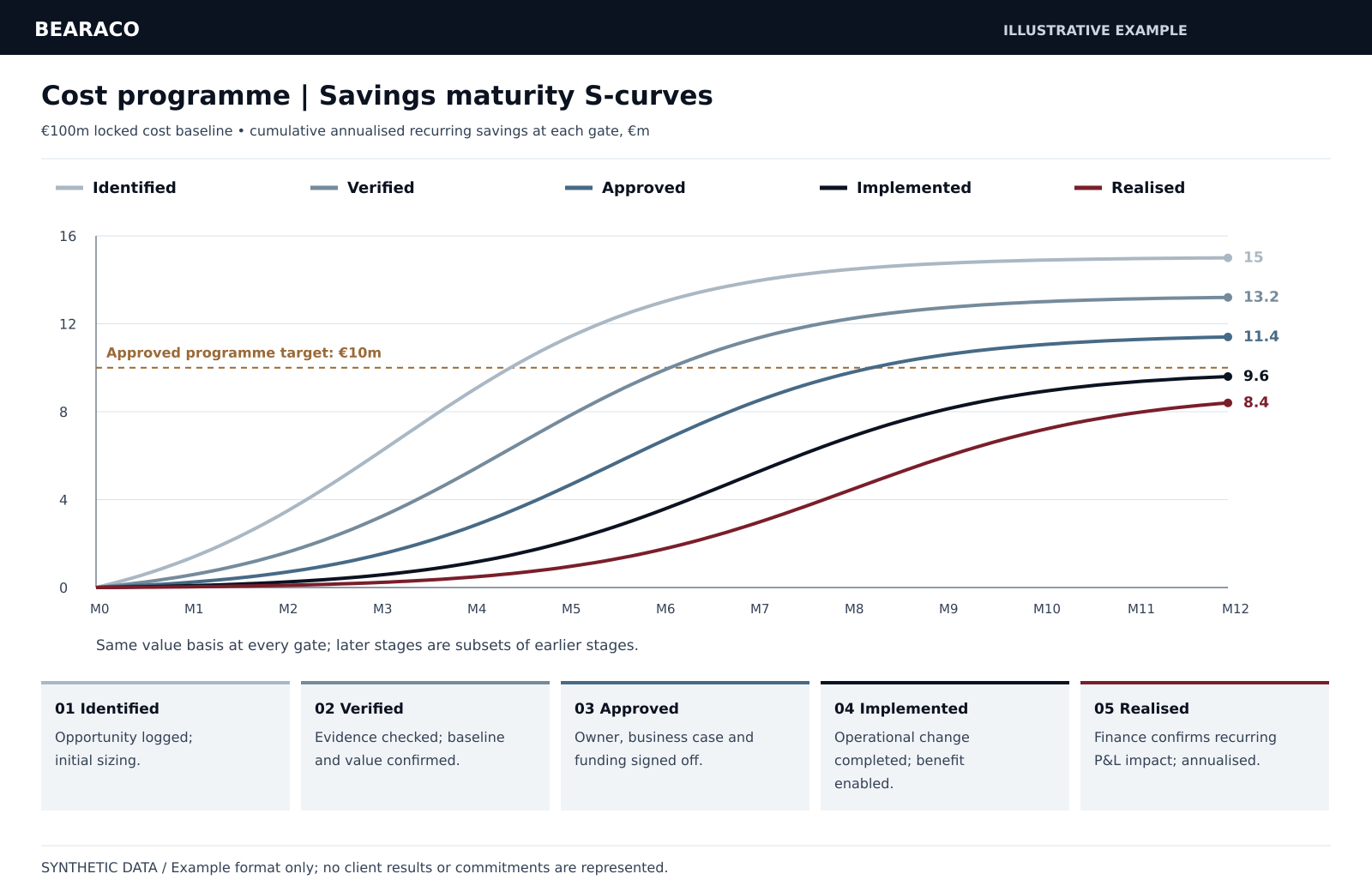
You get direct access to partner judgement, a team working inside your business and a shared focus on economic impact. We work through the difficult questions with you and stay close as decisions become action.
Selected anonymised engagements. Many span several services; each case shows the relevant areas of work alongside its outcome.

Construction & Real Estate · Cost Out
European construction group

Construction & Real Estate · Cost Out
European facility management provider

Telecom & Technology · Operating Model · Cost Out
Telecom operator
Figures are approximate. EUR conversions are documented in the full cases. These engagements illustrate experience, not forecasts for a new assignment.
If the baseline is reconciled, initiatives have capable owners and finance already validates realisation, use the existing management cadence rather than adding an external programme layer.