A covenant or lender conversation approaches
Cash forecasts, recovery assumptions and decision ownership are not yet aligned.

We help boards, CEOs and sponsors regain control when liquidity, a critical project or operating performance has moved outside the agreed plan.


Cash forecasts, recovery assumptions and decision ownership are not yet aligned.
Reported progress no longer matches the work left to complete.
Local management is stretched and multiple workstreams compete for the same resources.
Automation, systems and operational dependencies are being managed separately.
Four steps take the work from framing the question to executing the agreed changes, with service-specific activities and a decision gate at the end of each step. We agree the scope, evidence requirements and owners for each phase before work starts.
Duration: 1–2 weeks
Establish the immediate cash, delivery or operational position, identify critical decisions and set a joint reporting cadence. Start urgent stabilisation actions immediately.
Sponsor accepts a dated recovery baseline, with uncertainty and unresolved data explicitly marked.
Duration: 8–12 weeks
Test scenarios, prioritise actions and agree decision rights and escalation with stakeholders.
Partner challenges fact versus judgement; the accountable sponsor approves a funded plan and stop/go conditions.
Duration: 4–6 weeks
Stress-test the recovery scenarios, confirm funding and operational dependencies, and validate milestones with the accountable leaders.
The sponsor approves the tested recovery plan, funding, owners and stop/go conditions.
Duration: 6–18 months
Work alongside management to implement the recovery plan, resolve blockers and track cash, operational milestones and stabilisation.
Hand-back requires named line owners, stable reporting and evidence against the agreed recovery criteria.
Step 1: Frame
A dated view of the immediate cash, delivery or operational position, with critical deadlines, decision rights and stabilisation actions. Record uncertainties and assign owners to urgent decisions.
Step 2: Diagnose
A rolling 13-week cash forecast and operational or completion model, as relevant. Reconcile the starting position and quantify liquidity headroom, funding needs, cost to complete and the downside of delayed action.
Step 3: Validate
A stress-tested plan with prioritised actions, cash requirements, owners and milestones. Validate funding, dependencies and stop/go conditions with the sponsor before committing to the recovery path.
Step 4: Execute
Track actions, cash actuals versus forecast, operational milestones and recovery costs. Escalate variances and record decisions, with clear evidence and line ownership required for hand-back.
Each phase leaves a working asset with an owner, source references and an update process. Economic estimates distinguish potential value from approved commitments and realised results.
Illustrative example
Connect a four-week action schedule to a 13-week cash forecast, with named owners, recovery scenarios and decisions due this week.
Sample data, not a client deliverable. The format is tailored to the engagement.
View full-size example ↗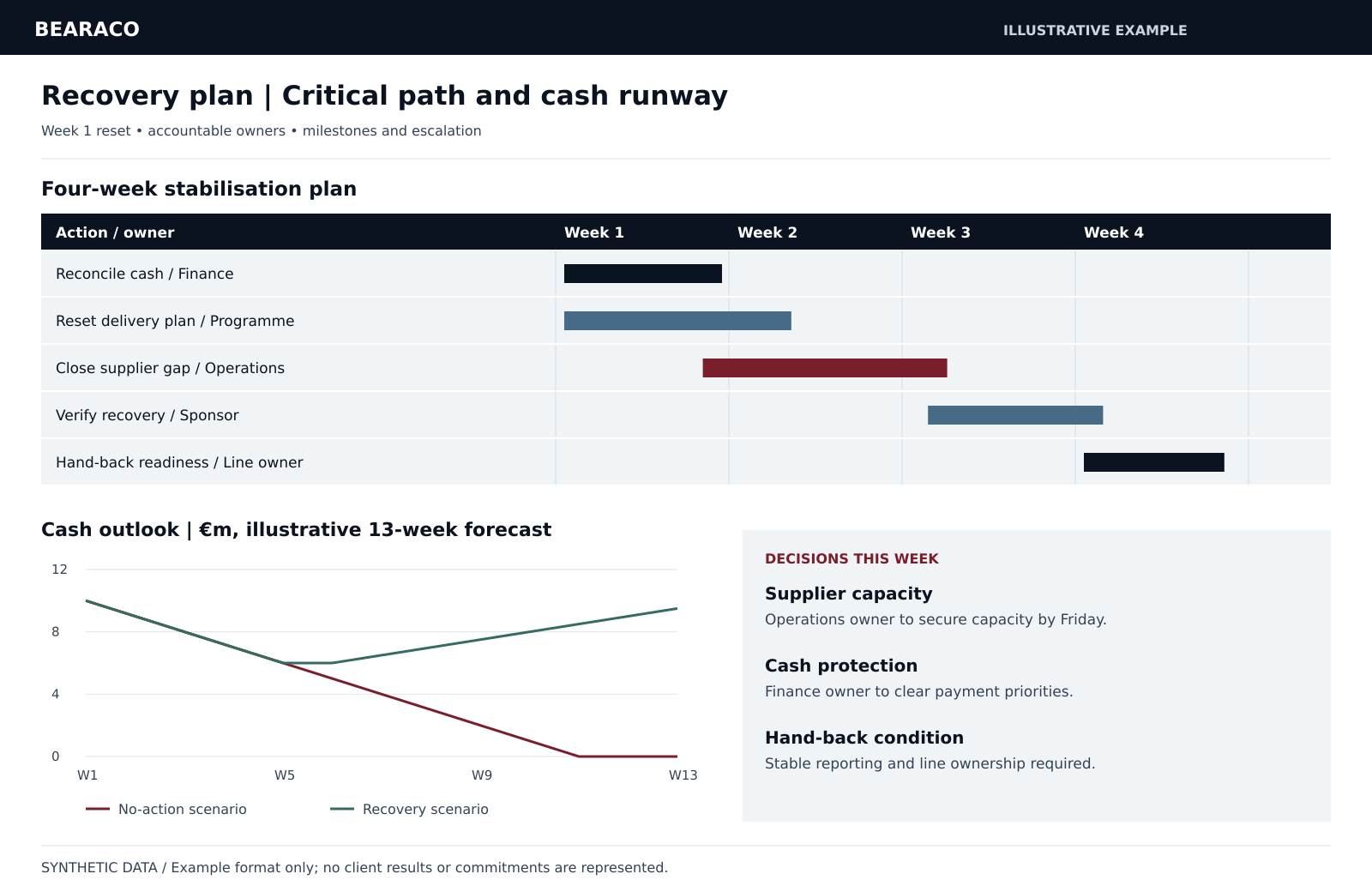
You get direct access to partner judgement, a team working inside your business and a shared focus on economic impact. We work through the difficult questions with you and stay close as decisions become action.
Selected anonymised engagements. Many span several services; each case shows the relevant areas of work alongside its outcome.

Consumer & Retail · Special & Urgent Situations · Growth & Commercial · Cost Out
European aftermarket business

Transportation & Logistics · Special & Urgent Situations · Operating Model
European postal and logistics operator

Transportation & Logistics · Special & Urgent Situations · Operating Model
Passenger rail operator
Figures are approximate. EUR conversions are documented in the full cases. These engagements illustrate experience, not forecasts for a new assignment.
If management has a reliable baseline, authority to act and enough execution capacity, a focused internal recovery cadence may be sufficient. Legal or formal restructuring decisions remain with the appropriately qualified advisers.