Bearaco

Capital should follow a choice you can defend.

We help boards, CEOs and owners resolve consequential choices about markets, portfolios and capital before committing the business.

Illustrative senior team evaluating expansion options around an industrial campus model
Choosing where to invest
Illustrative close view of facility plans and investment materials being assessed
Testing the investment case

When needed

A new CEO is inside the first 100 days

The mandate calls for a direction, but the portfolio and investment agenda still reflect the previous strategy.

An investment reaches the board without a tested downside

The recommendation depends on demand, delivery or residual-value assumptions that nobody has retested.

An acquisition or divestment changes the portfolio

The remaining businesses need a new capital allocation logic.

A business misses plan for a second cycle

Reinvestment, restructuring and exit remain live options, with no agreed basis for choosing.

Our approach

Four steps take the work from framing the question to executing the agreed changes, with service-specific activities and a decision gate at the end of each step. We agree the scope, evidence requirements and owners for each phase before work starts.

Duration: 1–2 weeks

Step 1: Frame

Agree the decision, alternatives, owner and deadline; reconcile the starting economics to management reporting.

Gate 1

Decision charter accepted by the sponsor; missing evidence and account reconciliations assigned.

Duration: 8–12 weeks

Step 2: Diagnose

Build market, portfolio and investment scenarios; expose the assumptions that change the answer.

Gate 2

Partner review separates sourced facts, modelled sensitivities and judgement; finance accepts the economic baseline.

Duration: 4–6 weeks

Step 3: Validate

Present the recommendation, downside conditions and a sequenced capital and action plan.

Gate 3

Board or sponsor records the choice, investment conditions and stop/go thresholds.

Duration: 6–18 months

Step 4: Execute

Translate the strategic choice into investment waves, accountable initiatives and management reviews. Work alongside the team to adjust the plan as evidence develops.

Gate 4

The sponsor approves each investment release against agreed thresholds; ownership and performance reporting are accepted before handover.

Deliverables

Step 1: Frame

Decision charter and value criteria

A signed brief defining the strategic choice, alternatives, decision owner and deadline, with agreed measures for value creation, capital employed and risk.

Step 2: Diagnose

Portfolio economics and valuation model

A reconciled business-unit baseline and editable market, cash-flow and valuation scenarios. Compare investment needs, return on capital and downside exposure, separating evidence from assumptions.

Step 3: Validate

Investment decision and funding pack

A tested recommendation with sensitivities, net present value, funding tranches and stop/go thresholds. The board or sponsor records the choice and the conditions for committing capital.

Step 4: Execute

Capital deployment and value tracker

An owned implementation roadmap and investment-release log, with actual cash flow and returns tracked against the approved business case. Variances trigger explicit decisions to continue, adjust or stop.

Each phase leaves a working asset with an owner, source references and an update process. Economic estimates distinguish potential value from approved commitments and realised results.

Illustrative example

Board decision sheet

Compare investment options in a risk–attractiveness matrix, test downside scenarios and set the gates for releasing capital.

Sample data, not a client deliverable. The format is tailored to the engagement.

View full-size example ↗
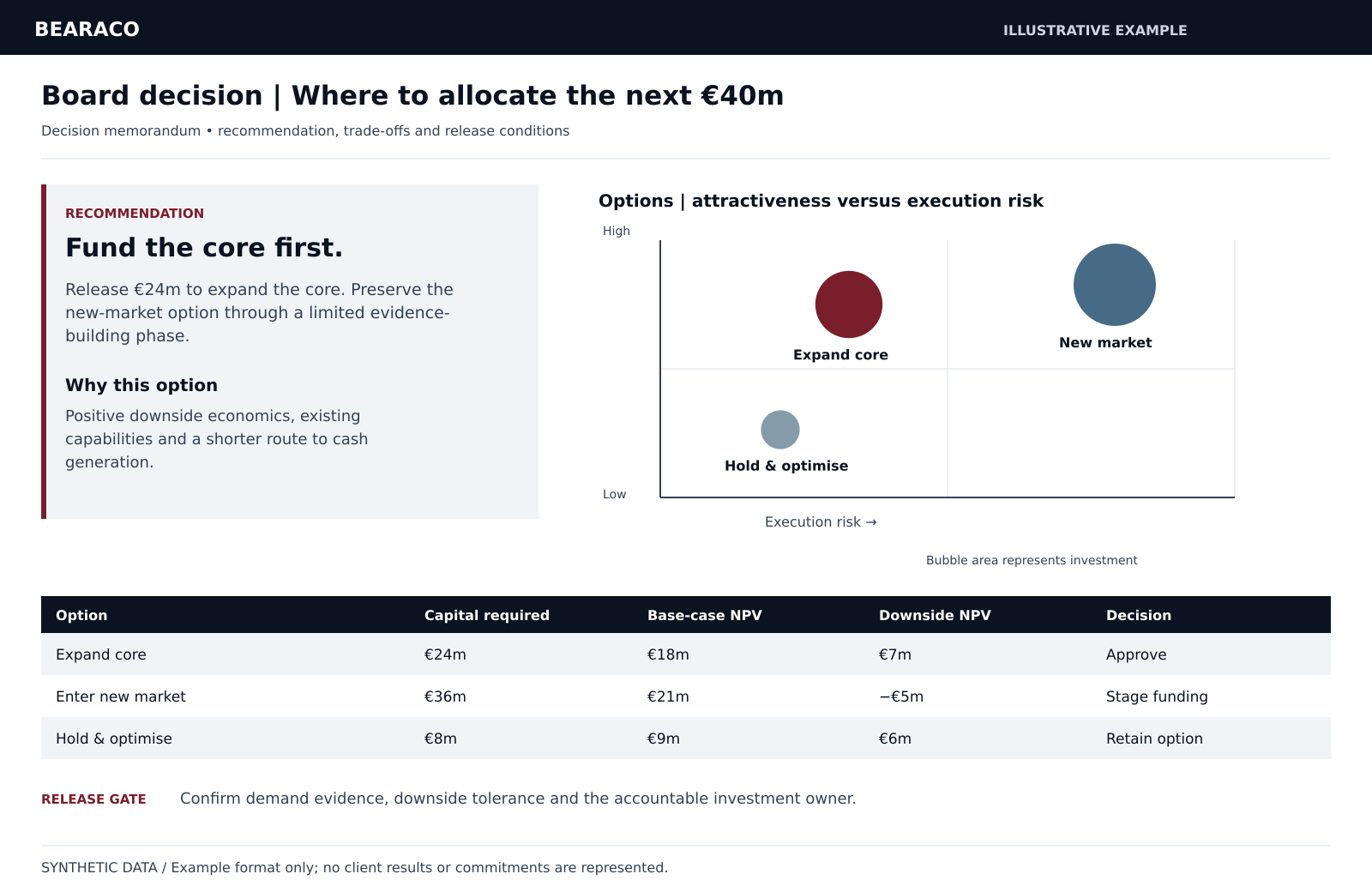
Illustrative board decision sheet with sample data. Compare investment options in a risk–attractiveness matrix, test downside scenarios and set the gates for releasing capital.

Team & Duration

You get direct access to partner judgement, a team working inside your business and a shared focus on economic impact. We work through the difficult questions with you and stay close as decisions become action.

A senior team, working with you

Partner judgement at the problem-solving table
1 accountable partner. Works directly on your hardest questions: shaping hypotheses, examining the evidence and developing recommendations with your team. Regular joint working sessions and partner-led decision gates bring senior judgement into the work throughout the engagement.
Day-to-day momentum, inside your business
1 Engagement manager. Works side by side with your people, including from your offices. Connects the analysis to operational reality, resolves blockers and turns decisions into owned actions.
Analytical depth focused on value
2–3 consultants. Combine rigorous analysis with our proprietary AI harness to test opportunities, quantify the economics and build practical working assets with your team. You gain a stronger fact base and tools your people can keep using.
Expertise that makes recommendations practical
1 expert. Brings relevant industry or service experience to test assumptions, challenge feasibility and identify the constraints that matter before you commit resources.

Duration & Fees

A clear path from question to impact
Duration of each step: Frame: 1–2 weeks. Diagnose: 8–12 weeks. Validate: 4–6 weeks. Execute: 6–18 months. We agree the scope, owners and decision gates before work starts.
Continuity from insight to execution
The partner and engagement manager are planned to stay from Frame through Execute, carrying the context and accountability into implementation. Any change to the core team is discussed and agreed with you.
Fee certainty upfront. Alignment on results.
Steps 1–3 (Frame, Diagnose and Validate) are fixed-fee, with scope and deliverables agreed for each step. Execute can include performance-based fees linked to agreed outcomes, baselines and measurement rules.
You control the next commitment
At each decision gate, choose to proceed, adjust the scope or take the working assets forward with your own team. Each further commitment follows an explicit decision, with ownership and handover built into the work.

Cases

Selected anonymised engagements. Many span several services; each case shows the relevant areas of work alongside its outcome.

Explore all Strategic Decisions cases →
Baselines, timeframes and evidence

Listed precision medical technology manufacturer

Starting position
A manufacturer with approximately EUR 350m revenue, 12 candidate geographies and three adjacent applications, with no ranked investment view.
Timeframe
Three-year investment-plan horizon; elapsed diagnostic duration is not recorded.
Recorded facts and outcomes
The market shortlist was reduced from 12 to four.
Judgement, targets and limits
The gated investment plan covered approximately EUR 53m over three years. The 15% annual revenue growth figure was an ambition, not an observed result.

European aftermarket business

Starting position
A national operation with approximately EUR 130m revenue, performing approximately five EBIT-margin percentage points below its group.
Timeframe
24-month performance condition following the strategic review.
Recorded facts and outcomes
The owner chose to retain and restructure rather than exit.
Judgement, targets and limits
An approximately 6% EBIT margin within 24 months was set as a condition for continued investment, not reported as achieved.

Figures are approximate. EUR conversions are documented in the full cases. These engagements illustrate experience, not forecasts for a new assignment.

Other services

When to do it yourselves

If the decision is reversible, the economics are already clear and your team has capacity to challenge the options, run the decision internally.

Talk it through with a partner.

Bring one pending decision, its deadline and the alternatives on the table. In a 30-minute conversation, we can test what evidence would change the answer and whether outside challenge would help.

Bearaco partners

Email a partner